[Jacob Schor writing with some parts copied from Allen’s last write up]
Last Friday, after the hike up Noyes Mountain, when we regrouped in the parking lot, the discussion turned to this week’s hike and Jeff mistakenly thought we were headed to Hermit Falls. That was an error, we are actually returning to Rattlesnake Mountain in Casco. Hermit Falls isn’t until next month.
Please note there are three aspects that need to be mentioned:
- The parking lot at Rattlesnake is limited and parking is not allowed on the road, so hikers should carpool when possible. Jeff is coming from the opposite direction most of us will be, so he will not heed this carpooling advice and will meet everyone at the trailhead. The rest of us should.
- I mistakenly used Google Maps to determine the parking lot location. Jane reminded me of how I got misdirected by my dashboard copilot last time I drove there. Do not turn off route 85 onto Libby Lane. The trailhead parking is just south of that corner on the West side of 85. Google seems to be directing us to the nearest overflow parking spot.
- No dogs are allowed on this trail. Ruby and Piper have been told.
Trailhead Address: Bri-Mar Trail, Raymond, ME 04071.
Directions: From Route 302, turn right onto Route 85 (Webbs Mills Road). Drive approximately 7 miles; the trailhead and a small parking area will be on your left, on the west side of the road.
https://maps.app.goo.gl/pGU8wyFHCGnq5xzn6
We last hiked Rattlesnake Mountain two years ago, that would have been Nov 8, 2024.
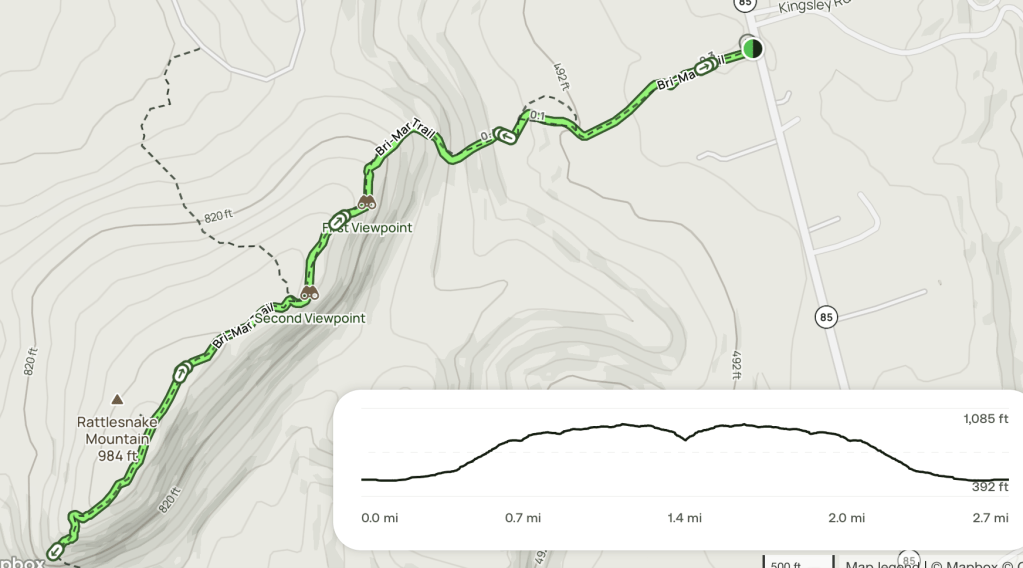
Rattlesnake Mountain in Casco is a small, 1,035 foot mountain with great views from the summit ledges, after a short about 1.0 mile climb. Despite the name there are no longer any rattlesnakes on Rattlesnake Mountain. They were once common up until the 1880’s but there was a vigorous effort by local farmers to eradicate them. The snakes were also hunted for their medicinal value, becoming something of a cash crop. Any trace of rattlers has been eliminated long ago.
No rattlesnakes have been seen anywhere in Maine since 1901. or at least that’s what we want to believe. An article in The Windham Eagle from 2024 by Walter Lunt describes a rattle snake sighting within living memory. link.
The Timber Rattlesnake (Crotalus horridus). for which this mountain is named, was once found from the Massachusetts border up to the White Mountains in Maine and New Hampshire. However, not only is it no longer found in Maine, there is only one known population in New Hampshire where it is on the State Endangered Wildlife list as Critically Imperiled. The Timber Rattlesnake is a large, thick black snake measuring 36-60 inches with a large triangular head and a large rattle at the end of the tail. We will assume that none of our hikers will be too disappointed if we fail to see a specimen.
Apparently an early settler named John Cash along with another local inhabitant named “Rattlesnake Ben” Smith captured snakes and then rendered oil from the snakes to treat rheumatism. This would have been genuine snake oil rather than imitation.
The idea that snake oil was, or specifically rattlesnake oil, is a panacea was not widely promoted in America until a man named Clark Stanley, who called himself the Rattlesnake King,. arrived at the 1893 Columbian Exposition in Chicago. Apparently, in his telling, he had spent 11 years working as a cowboy and during that time learned his snake craft from a Hopi medicine man.. He dressed as a flamboyant cowboy, and debuted his snake oil in a showman-like performance, slaughtering and boiling live snakes on stage and then bottling the oil and selling it directly to customers. This occurred years after our local Casco snakes were gone. The last snake capture in Casco is said to have happened in 1870 twenty-three years before Clark Stanley started his business. The last rattlesnake sighting in Maine apparently was in 1890.
The names of two of our local bodies of water once known as Great Rattlesnake and Little Rattlesnake had their names changed in the 1929 to Crescent Pond and Raymond Pond.
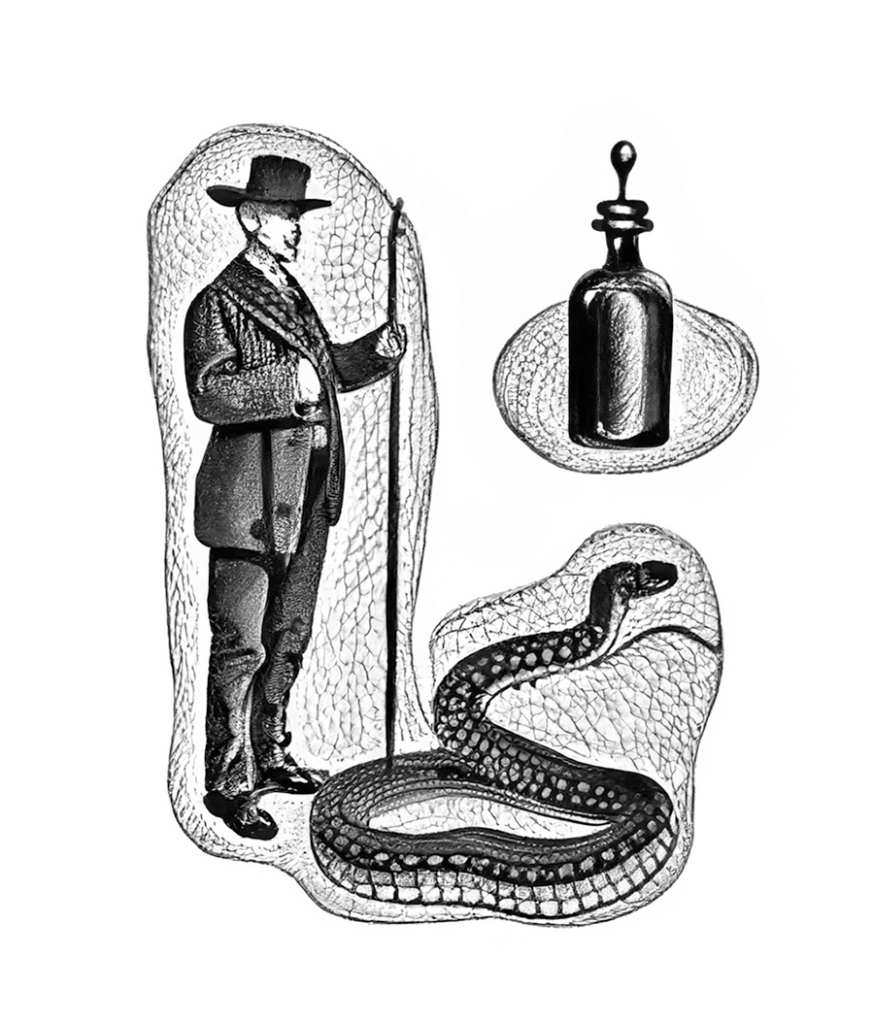
From the Windham Eagle Oct 29,, 2021
Legendary Ben Smith and the allure of Rattlesnake Mountain
By Ernest H. Knight
One of the early settlers in Raymond on Raymond Hill was Ben Smith, who came to the area from Dover, New Hampshire as a runaway boy in 1787.
On a trip to explore a nearby mountain, Smith found it infested with timber and common rattlesnakes and gave that spot its present familiar name.
The mountain was about five miles from his farm and Smith became famous in Maine for his business of peddling Rattlesnake Oil for rheumatic and neuralgic pains.
As a sideline to farming, Smith’s business involved catching rattlesnakes, extracting their oil and venom, and then selling it locally and the Portland area for its therapeutic value as a liniment for rheumatism and anything else needing a sure cure.
To prove his product genuine, he carried live snakes with him on his travels and attracted attention by putting a live snake inside his shirt and letting it crawl around his body.
Smith was bitten at least once, and it was reported by his friends that he ultimately took on one of the characteristics of rattlesnakes in that his tongue constantly darted in and out of his mouth.
He had experimented to eliminate the hazards of his act by pulling out the snake’s fangs with the pincers he used in repairing his boots and apparently his research paid off as he lived to the age of 82, expiring in bed surrounded by a few of his reptilian pets.
Through overkill and forest fires, the rattlers eventually became extinct on the mountain and the last known capture of a rattlesnake in Raymond was reported at Webbs Mills about 1870.
Rattlesnake Mountain with its rocky terrain and once massive oak forests were a source of knee, stem, keel and other pieces required for building Maine sailing vessels. Rather than haul heavy and awkward timbers, forks and roots to the waterfront shipyards, patterns for needed shapes were brought to the mountain for the hewers to use in removing the excess material.
With a limited supply of suitable trees which nature could only make by 100 or more years of growth, it is fitting that the building of wooden ships was abdicated when the use of iron became popular for shipbuilding.
Another product of never-ending supply but of diminished demand is split granite building foundation for stones and walls. It was once an active business as it was split from boulders and ledges by hand with a hammer, rock drill and wedges.
The Berry Brothers, John, Charles, and George, who lived on Plains Road, were practitioners of this craft and who from their outcropping on Rattlesnake Mountain split all the stone wall surrounding Riverside Cemetery near their home. Split stone has since given way understandably to concrete, brick, and cement blocks though the glamour has been lost. <
This article was written by the late Ernest H. Knight, one of the founders of the Raymond-Casco Historical Society and contained in his book “Historical Gems of Raymond and Casco.” It was submitted by the Raymond-Casco Historical Society and articles about Raymond history from the historical society will appear regularly in The Windham Eagle newspaper. To find out more about the Raymond-Casco Historical Society, call Frank McDermott at 207-655-4646.

Leave a comment