Douglas Mountain
8-26-26
Douglas Mt Hike Report
August 28
by Jeff Sturgis
Sixteen Denmark Mountain Hikers met at the Douglas Mountain parking lot in Sebago on a humid, warm morning. Hiking today were Jeff Sturgis, Dale Nelson, Kitty Nelson, Paul Waterhouse, Moe Pakulis, Elaine Camelio, Sandra Bell, Ron Paquette, Jean Murch, Janet Arens, Phil Johnson, Kathy Huchthausen, Greg Dean, Greg Moulton, Robin Marciello and Bev Reid. Greg Moulton agreed to be our lead, while Phil Johnson was the sweep.
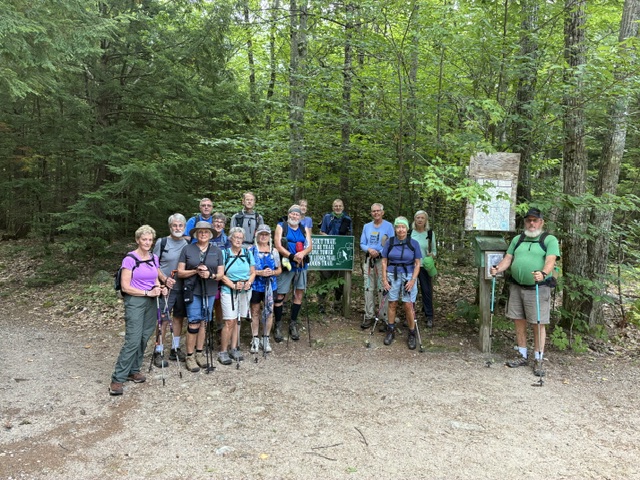
After our trailhead shot, we left the parking lot at 9:10 AM heading up the Scout Trail which covers about a mile and a half to the summit. The trail follows a snowmobile trail at first, which has negligible elevation gain. But once it branches off, the trail becomes fairly steep. We eventually reached a notch at about 15 minutes below the summit where the Nature Trail loops off to the left and the Scout Trail takes an abrupt turn, which after a short dip, climbs steeply to the stone tower at the summit.
Four of our number chose to take the scenic route while the rest of us headed directly to the summit. The high humidity led to “interval” hiking for some of us: short bursts with frequent rest stops to hydrate and catch our breaths. The main body of hikers reached the summit at 10:15 AM with the four sightseers arriving about 10 minutes later.
The summit has several structures that were erected in the 1920’s by Dr. William Blackburn who owned the mountain and eventually donated it to the Town of Sebago. The first is the stone tower that one can climb and has spectacular views including of Sebago Lake, the wide Pleasant Mountain ridge and glimpses of Evans Notch and White Mountains.
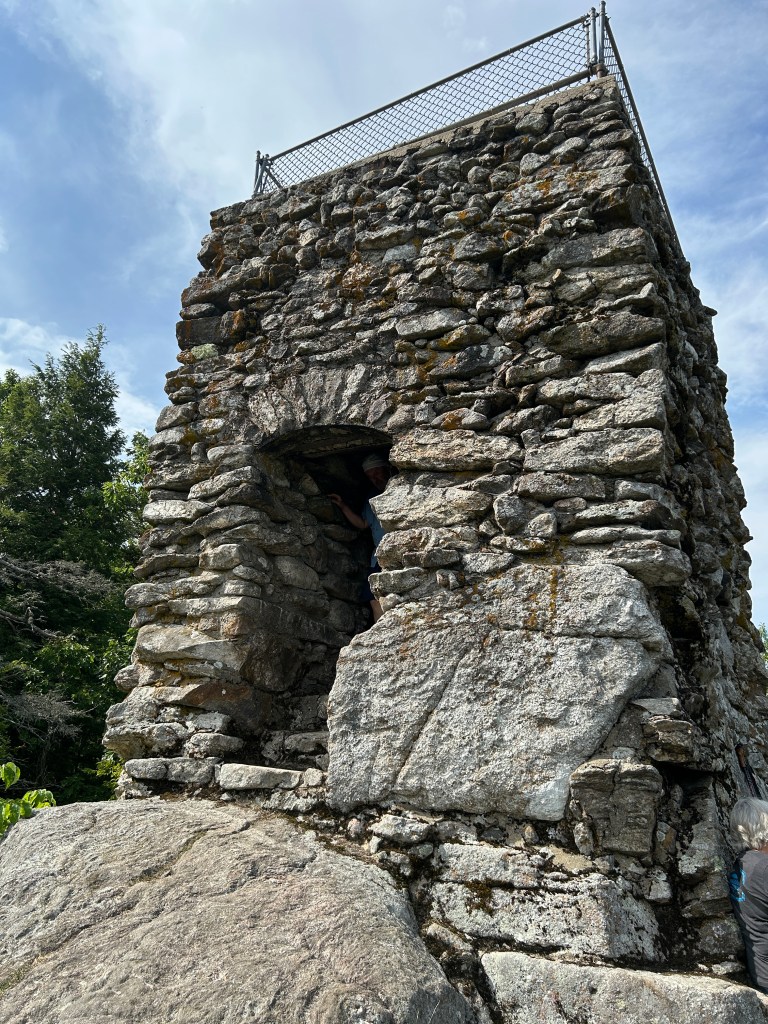
There is also a unique beehive fireplace that has a shelf above the fire pit, probably for warming food and baking. Finally, there is a big rock that is engraved with the Latin phrase “non sibi, sed omnibus” – “not for one, but for all.”
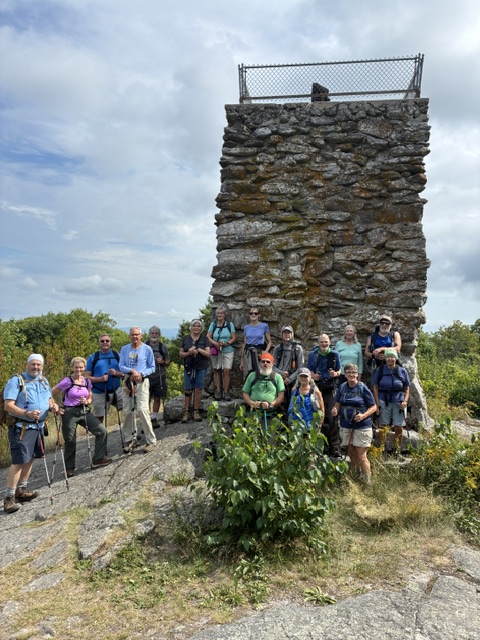
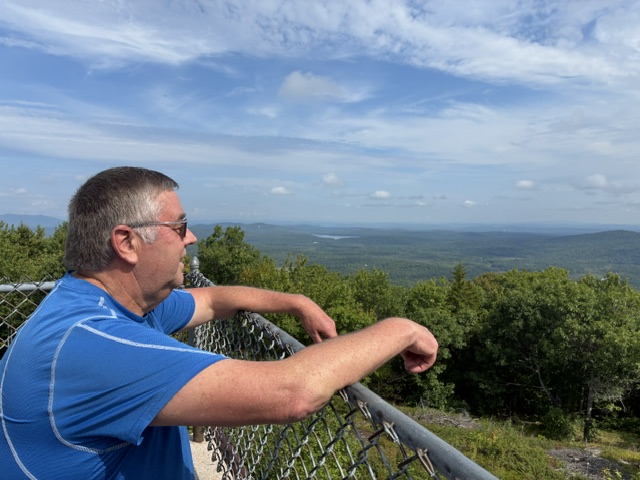
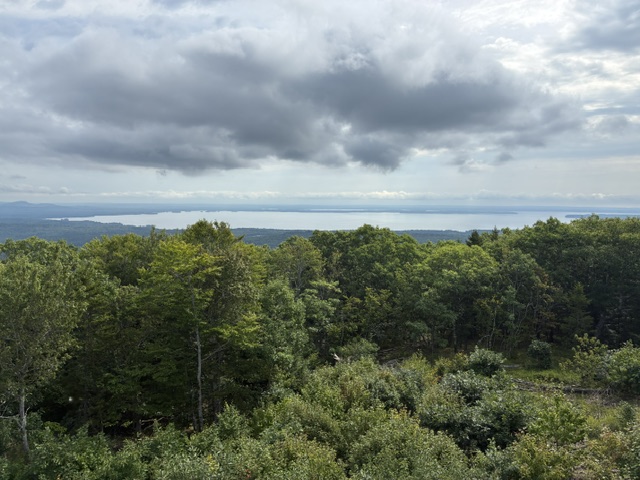
We spent a very pleasant 35 minutes enjoying our snacks, Robin’s cookies, the views from the tower and each other’s company. At 10:50 another hiker graciously volunteered to take our group picture, and then we headed down the short Woods Trail that comes out on the Douglas Mountain Road. Notable on this leg were several wells and cisterns that supplied water to the houses on the road below it.
We completed our loop by walking down the road past several very nice homes with great views and turning into the dirt road that leads back to the parking lot. At 11:30 we reached our vehicles after 2.24 miles of hiking, with an elevation gain of 407 feet and 1 hour and 22 minutes on the trail, according to our AllTrails app. While the high humidity impacted our pace up the mountain and the lack of a breeze gave little relief to those conditions, this was a very nice summer hike with a great payoff at the summit.
Next Week:
September 4 – Easy – Patterson Hill (965 ft), Lovell, ME. 2.2 mi RT, 516 ft. of elevation gain. RT hiking 2 hours. RT driving 1.5 hours. (HL – Dale Nelson)
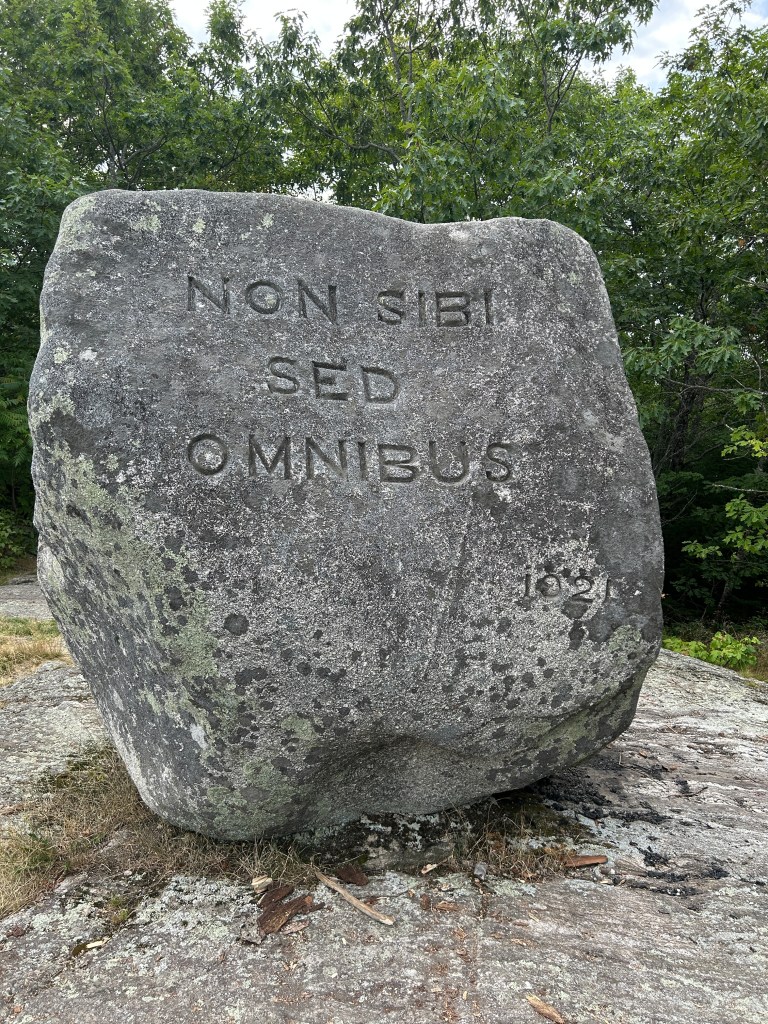
“non sibi sed omnibus”
Addendum from Jacob Schor
Greg Moulton Moulton shared this photo of the boulder on top of Douglas Mountain with the ‘non sibi sed omnibus’ engraved on it, advising, “Not for oneself but for all”.
Greg wrote, “There is also a date that’s difficult to see, but I think it is 1921. In the 1920’s, Dr. William Blackman donated the land containing Douglas Mountain, to be used for public recreation. He also donated funds, which were used to build the stone tower and other features. He had the boulder inscribed with the Latin motto, to reflect his belief that this beautiful spot was not for him to keep to himself, but to share with others.
I’ve seen this rock many times, since climbing Douglas Mtn. as a kid. I thought it was pretty cool then, and I still do.”
As I added this blurb of Greg’s to Jeff’s hike report I took a slight detour to investigate this further.
The Latin phrase, “Non sibi sed omnibus” is of interest, especially if considered in our current political and economic context.
While not a direct quote from Cicero, its sentiments trace back to his classical humanist philosophy and is a variation of the older Latin phrase, “ non nobis solum” (not for ourselves alone).
The phrase was often adopted as a motto during the 19th-century by civic organizations, especially volunteer fire departments, schools, and other institutions that prided themselves on public service.
There does not appear to be a definitive initial use of the term in any classical text that stands alone as a quote. Rather it seems to have slowly evolved from Cicero’s famous treatise called, “De Officiis” (On Duties) that includes the line: “Non nobis solum nati sumus ortusque nostri partem patria vindicat, partem amici.”
(We are not born for ourselves alone; our country and our friends claim a share in us.) This sentiment seems, over the centuries, to have been shortened over to Dr. Blackman’s version.
The shift from non nobis (not for us) to non sibi (not for oneself) was influenced by a Roman military adaptation to non sibi sed patriae (“not for self, but for country”). The word omnibus (“for everyone/all”) came into use in Latin translations of the Bible and early modern civic legal texts, which emphasized public good (bonum commune).
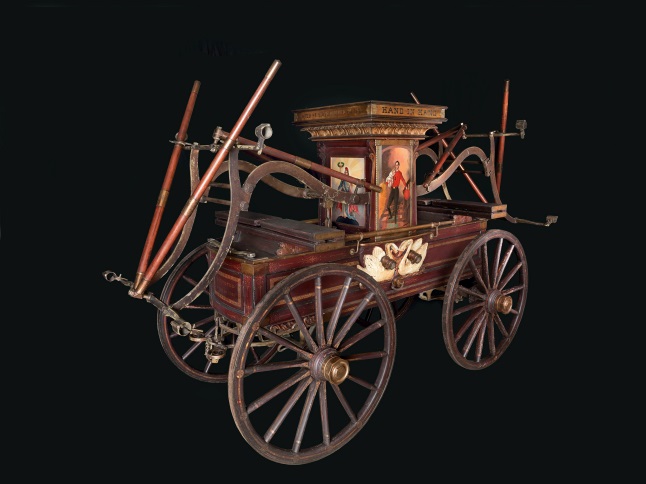
We see the Blackman version of phrase appearing in the 1700s and 1800s, with perhaps the earliest existing appearance on a rather ornate firefighting pumper that was once owned by the Hand in Hand Volunteer Firefighters.
Marcus Tullius Cicero is remembered as an academic skeptic and eclectic thinker as well as a civic leader during the collapse of the Roman Republic. Cicero considered philosophy an essential guide for political duty, leadership and public service.
His perhaps most influential contribution was his conception of Natural Law (Lex Naturalis). He argued that true law is not simply what a government passes by vote. It is unchanging, eternal reason inherent in nature. He proposed the existence of universal morality,, the idea that right and wrong do not change based on culture or geography and the reason binds humans to a universal moral code. Any human laws that contradict this natural moral order is inherently unjust and invalid. These specific beliefs shaped the thinking of John Locke and then the framers of the Declaration of Independence.
Cicero wrote De Officiis as a letter to his son in which he describes how a virtuous person balances moral rightness with practical utility. He writes of four cardinal virtues: Wisdom, Justice, Fortitude, and Temperance.
One might go on at length about Cicero (and some might suggest that I already have) and his thinking as many of his texts are still available and relevant, but for our group of hikers, there is one of particular relevance.
That is his treatise on growing old, titled Cato Maior de Senectute (usually called How to Grow Old). It is one of Western history’s most celebrated and optimistic reflections on the aging process. Cicero wrote it in when he was 62 years old—(BTW, just a year prior to his execution)—the work is written as an imagined dialogue set about a century earlier. The conversation is not with Cicero but with the Roman statesman Cato the Elder, who, at age 84, addresses and then dismantles the society’s anxieties and negative stereotypes surrounding life’s later years.
Rather than viewing this stage of life as an inevitable downhill slide, Cicero/Cato argues that a structured and virtuous mind can turn old age into a season of unmatched wisdom, intellectual fruitfulness, and quiet peace.
Cicero has Cato address the four complaints most people have about getting old:
- Complaint 1: Aging withdraws us from active pursuits.
Cicero argues that while physical or manual labors diminish, older adults transition into far more vital roles. They lead through governance, wisdom, and counsel rather than raw muscle. He points out that a ship requires a steersman sitting quietly at the helm just as much as rowers. - Complaint 2: Age weakens the physical body.
Cicero counsels that a healthy spirit accepts the natural limitations of the physical form. He asserts that an older person should no more yearn for the raw vigor of youth than a young man should yearn for the physical power of a bull or an elephant. Physical decline can be mitigated by continuous intellectual exercise and moderation. - Complaint 3: It deprives us of physical pleasures.
Rather than a tragedy, Cicero treats the natural fading of intense physical or sexual appetites as a profound blessing. Age liberates the individual from the chaotic tyranny of raw desire, clearing the path to enjoy much more fulfilling pleasures. These include deep conversation, reading, and gardening or agriculture, which he describes as deeply nourishing to the soul. - Complaint 4: It places us near the doorstep of death.
Cicero takes a stoic approach, asserting that death is a natural transition to be met with dignity, not fear. He beautifully contrasts the deaths of the young and old: the death of a young person is like a raging fire violently extinguished by a torrent of water, whereas the death of an older person is like a mature fire going out quietly of its own accord once its fuel is spent.
There’s a lot of thinking to unpack and carry home found in that boulder that Dr Blackman left us on top of his hill in Sebago.

Leave a Reply