Sept 2026
Jacob Schor
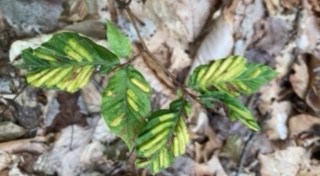
Beech leaf disease (BLD) was first found in Ohio in 2012. Since then it has spread steadily, reaching Lincolnville, Maine in 2021. Loon Echo Land Trust first reported finding beech leaf disease on lands they manage in mid-July in 2025, identifying cases in LELT forests in Sebago and Casco. The disease spreads rapidly and now threatens trees across all 16 Maine counties.
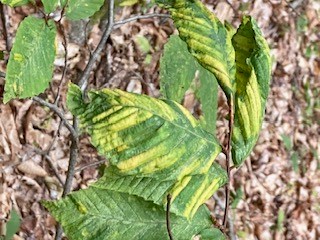
BLD is caused by a non-native, microscopic roundworm, Litylenchus crenatae mccannii, which feeds inside the tree’s dormant buds and leaves. This tiny nematode was first found Japanese Beech trees, but only caused mild symptoms to the Japaanese trees. Here in Maine it’s a different story; to our beech trees the disease seems to be fatal. Because the nematodes overwinter in leaf buds, they infest young trees that have leaves closer to the ground and so more vulnerable. Young saplings are hit hardest suffering severe leaf loss and quickly die, sometimes in just 2 to 3 years. Older trees also show symptoms, but decline slower, taking 5 to 7 years to die.
The best website to learn more about this is https://www.maine.gov/dacf/mfs/forest_health/invasive_threats/beech_leaf_disease.htm
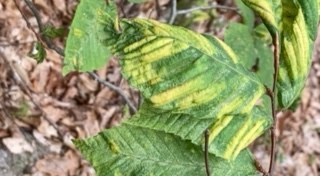
You can spot BLD by checking beech leaves for several distinctive signs:
• Dark banding/striping between beech leaf veins, which is especially apparent when held up to the light
• Leaf curling
• Leathery texture on leaves
• Aborted leaf buds, branches severely lacking leaves, reduced canopy
• Leaves that are smaller in size
• Yellowing leaves
• Twig and branch die back
We’ve been seeing signs of BLD since last summer when the State Forester pointed our signs of the disease o our trees. These photos were taken today, Sept. 9, 2026 near the north end of Peabody Pond. Given that most if not all our Beech trees already have Beech Scab Disease, the future for Beech trees in Maine is not promising.
At this point there doesn’t seem to be much we can do about the disease, at least not here in the forest. Apparently, with solitary urban trees one can treat them with insecticide but that wouldn’t be practical here. One suggestion is to wait and watch in the hope that some trees will display resistance to the disease. That tree’s seeds might then be used to grow other resistant trees. We should point out that a similar strategy did not work all that well for the Chestnut or Ash trees in the past.
Beech trees are of course the source for beech nuts, which are an important high fat, high caloric source of calories for many forest dwellers. The list includes deer, squirrels and particularly black bears. Nuts from American beech (Fagus grandifolia) are smaller and sweeter, than those from European beech trees (Fagus sylvatica). The European nuts while larger often contain higher levels of tannins and saponins that may cause indigestion.
I was long under the false impression that Beech-nut gum was somehow made from beech-nuts or at least flavored with beech extract. Nor is there any component of the tree in Beech-nut Baby Food, which is an offshoot of the gum and confectionary company. There is some hint that the original beech-nut company that was started in the late 1800s that made and sold smoked hams and bacon might have used beech wood in their smoke house.
If you want to savor the flavor of wild beechnuts, this is probably the year to do so. Your opportunity may not last long.
Reminder. There are two hikes on the schedule for this week:
September 11, 2026: Dual Hikes.
Middle Sister OR Church Pond

Leave a comment